

We are taking time to slow down and think over the prayer that the Lord Jesus taught His disciples in the Great Sermon on the Mount. So far, we have considered how Jesus teaches us to open our prayers with a right view of God – acknowledging the intimacy of relationship that we are welcomed into so as to call Him Father, and yet the reality of our smallness and His greatness as the King of the Universe. Jesus then calls us to come to this God with our needs, firstly, our physical needs: Bread for our bodies and now secondly, our spiritual needs: mercy for our souls.
“Forgive us our debts . . .”
It is easy for us as New Testament believers to take this part of the prayer as ordinary, but for those congregated on that Judean hillside, this part of the prayer is profound and extraordinary. For them then, the way to be forgiven was costly, bloody and taxing. It was not a matter for simple prayer, but an event that took an incredible amount of time, money and effort.
This is what the Law of Moses set out, “If anyone of the common people sins unintentionally in doing any one of the things that by the Lord’s commandments ought not to be done, and realizes his guilt, or the sin which he has committed is made known to him, he shall bring for his offering a goat, a female without blemish, for his sin which he has committed. And he shall lay his hand on the head of the sin offering and kill the sin offering in the place of burnt offering. And the priest shall take some of its blood with his finger and put it on the horns of the altar of burnt offering and pour out all the rest of its blood at the base of the altar. And all its fat he shall remove, as the fat is removed from the peace offerings, and the priest shall burn it on the altar for a pleasing aroma to the Lord. And the priest shall make atonement for him, and he shall be forgiven.” (Lev. 4:27-31)
As we come to our Heavenly Father, the King of the Universe, we also come to the holy God against whom we have sinned. Since Genesis 3, we are those who rebel against the only Good and Holy God. We refuse to believe Him and choose to go against His Word, doing what “ought not to be done” (v27); “for all have sinned and fall short of the glory of God” (Rom. 3:23). Because of this, there is a breach (break/separation) in relationship with God. Only God, the One who is sinned against, can accurately provide a way for this breach to be fixed. In the Mosaic covenant, in which Jesus’ original hearers were living, the means provided for was the sacrificial system.
As it has been described in the passage from Leviticus, in the event of a person’s guilt and awareness of sin, that person was to acquire a female goat/lamb, without blemish. They were not to get any animal that they wanted, they were to get a healthy, whole female goat/lamb – the best they could find. Please note that as the owner of such a goat or lamb, the inclination would be to keep it and perhaps use it to breed other good goats or sheep and maybe sell them for profit. Those who did not own such an animal would have to buy one. But the issue of sin is no small feat. It is not mere inconvenience that one has caused the Lord, but the greatest violation of His holiness and insult to His character. To repair this breach was meant to be costly and painful.
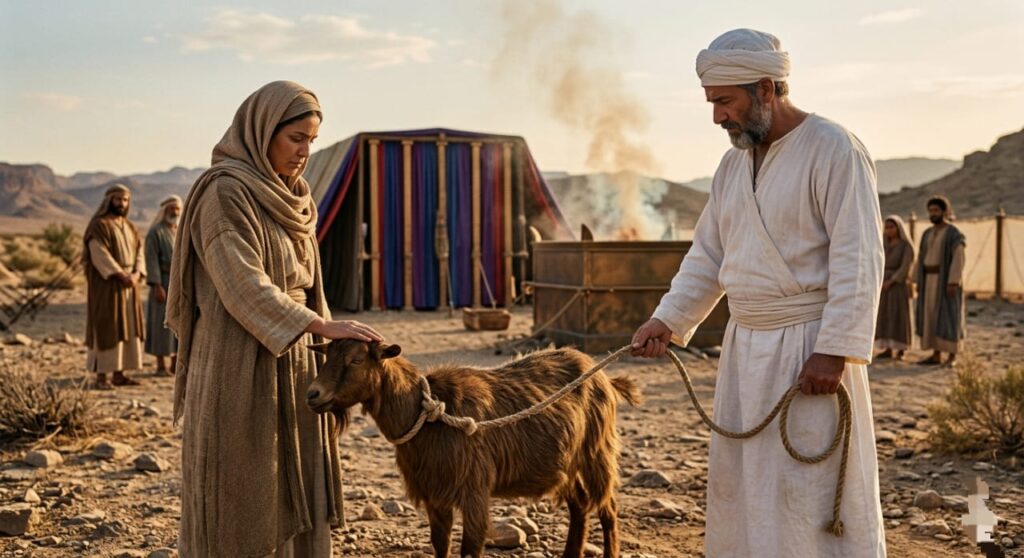
This animal was then to be brought “to the entrance of the tent of meeting” (Lev. 1:3). When Jesus was speaking, the Temple courtyard was the place to bring one’s offering. They were then to place their hand on the animal’s head, “and it shall be accepted for him to make atonement for him” (1:4). By placing one’s hand on the head of the animal, a kind of transfer of sins happened. An exchange had happened whereby, the animal now took on the sins of the sinner and the person would take the innocence of the animal. The animal now stood for (in place of) the sinner.
The animal would then be killed by the priests and the blood spilled on the sides of the altar as an acknowledgement of and payment for sin and the fat would be burnt on the altar as a pleasing aroma to the LORD (4:29b-31a). In this way, the priest would “make atonement” for the sinner. The word atonement can be broken down to reveal it’s meaning: at-one-ment. It is the state of harmony that is restored to the relationship between that individual and God. Through the sacrifice, God and the sinner could relate again, brought into oneness once more and so the person would be forgiven (4:31). The animal would die in the place of the sinner, who deserves death for their breach against God, and the person would go away free and forgiven, able to relate well with God. A burdensome, costly, bloody affair! But now, as Jesus is teaching this congregation, He says that through a few penitent words, a sinner can ask for forgiveness and receive it? How?
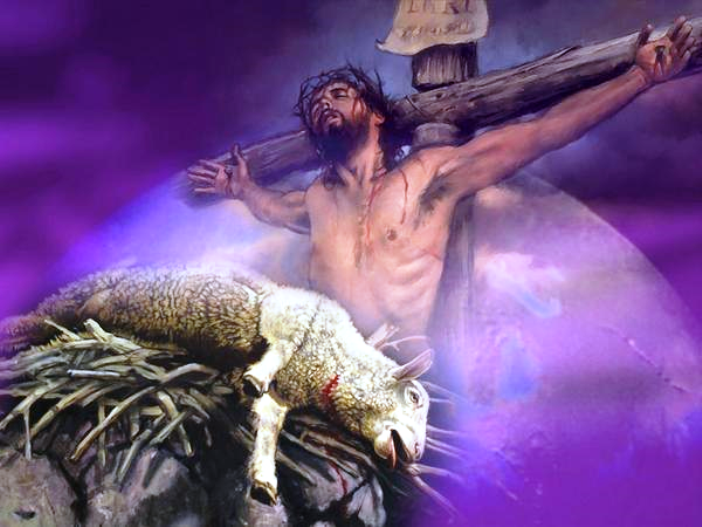
While the prayer does not go into the details, we who know the way the story will unfold, know that Jesus is the One through whom this forgiveness will come. He will be “the Lamb of God who takes away the sin of the world” (John 1:29). He will take on the sin of the world as a fitting Substitute (having our flesh, yet fully God), the final one that would ever be necessary and would face the punishment for it once-for-all so that sinners can know true and lasting at-one-ment with the Lord God! I cannot say it better than these verses from an old hymn by Charles Weasley:
Tis finished! the Messiah dies,
Cut off for sins, but not His own,
Accomplished is the sacrifice,
The great redeeming work is done.

Tis finished! All the debt is paid;
Justice divine is satisfied;
The grand and full atonement made;
God for a guilty world hath died!
For us who read this today, we can come with the confidence of the death Jesus faced 2000 years ago on a Roman cross. He willingly faced the burden and cost of our sins, bleeding to death, as our representative so that we can know the pardon for our sins. He was the perfect, blameless offering, made without blemish, who dies and accomplishes once and forever the penalty for sins. Because of this effective sacrifice, there is no longer any need for repeated sacrifices because Jesus has paid it finally and fully. Therefore, we can by faith in Him, trust the work He has done as our Substitute and come to God and use simple words to ask for our sins to be forgiven! What a marvelous salvation! We neither need to die for our own sins as we deserve, nor need to acquire inadequate substitute animals to do so either. Jesus stands for us and guarantees for us the forgiveness of our sins! Hallelujah!
And so Jesus can confidently teach those bound under the Law to pray in anticipation of the freedom that He will bring. We who live on this side of the Cross of Christ can look back to Calvary and confidently pray, “forgive us our debts”, because we know Jesus has paid all that we owed, and so the Just God will forgive us. Amen!
May we not think to say these words as some kind of incantation – as if the words themselves hold the power apart from a truly remorseful and repentant heart. This is why I want us to slow down over this prayer: that we might take more seriously the realities it is revealing and calling us to bank on. May my heart and yours not take God’s generosity for granted and use His kindness as license to sin and not take to heart the cost for the forgiveness offered to sinners. May God help us to humbly pray, “forgive us our debts”.