

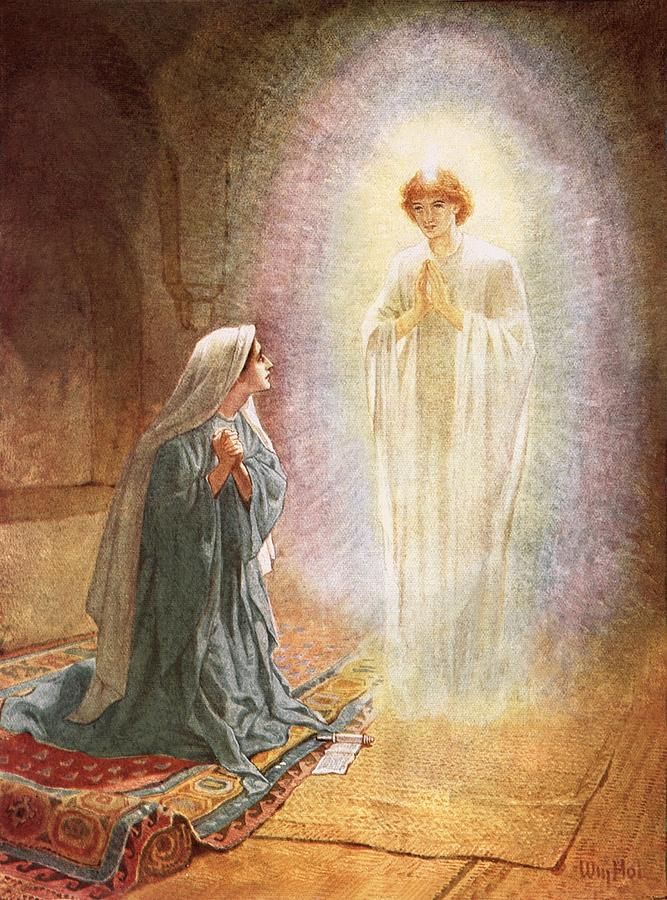
These are the words of Mary, the mother of Jesus in Luke 1:38. An angel had just appeared to her and announced to her that she was favored by the Lord and would therefore have a child, “the Son of the Most High”, the Messiah (v32-33). She was told that this would happen by the power of God and as proof, she was told that her elder relative Elizabeth was also pregnant – 6 months along. “Mary said, “I am the bondservant of the Lord; let it be to me according to your word.”” These words have stayed with me since Christmas. They represent to me (and I think any keen Christian) extraordinary devotion to the Lord.
I recently took some time to think about what the term bondservant meant in Jewish culture. It traces back to Exodus 21:5-6. The rules around having a Hebrew slave were that they could only serve as a slave for six years and then be freed in the seventh. However, there was a circumstance in which they could serve longer.
“But if the slave plainly says, ‘I love my master, my wife, and my children; I will not go out free,’ then his master shall bring him to God, and he shall bring him to the door or the doorpost. And his master shall bore his ear through with an awl, and he shall be his slave forever.” (Ex. 21:5-6)
There are four big things to consider:
- “I love my master, my wife, and my children”
This status of bondservant was by the initiative of the slave himself. It was him who considered extending his slavery, “I love my master and all that he has given me.” The servant is driven by love for the master and all he has graciously given. In the case of the OT servant, the master had given him a family of his own – a wife, with whom he had gotten children. He was not willing to leave his master or his ‘gifts’ behind. He has received good from his master and responds to this good with love.
- “I will not go out free”
The servant then chooses to commit himself to the Master; forgoing his freedom. The servant truly has the option of going away free, but he is not willing to leave his master and what he has graciously given and so surrenders his freedom! His love overflows into action – surrender and submission to his master.
- “And his master shall bore his ear through with an awl”
The servant would then go with his master before the Lord – likely to the Tabernacle, where this commitment would be made public. This choice to commit would however come at a cost – he would have a physical marker that would come at great pain. He would have a hole made in his ear – not a simple piercing but a noticeable hole that would testify to his commitment to his master. Some later references to this mark speak of it as an “open ear” (cf. Ps. 40:6; Is. 50:5), insinuating that there might even have been a chunk missing from the ear (perhaps torn out from the servant pulling free from the awl affixed to the tabernacle doorpost?! Ouch!)
- “and he shall be his slave forever.”
This choice and commitment was then for life! It was a surrendering of freedom, not for a little while, but until death! Perhaps it is in reference to this that people started thinking of marriage as a form of slavery? Whatever the case, I imagine that there were not many bondservants walking around. It does not strike me as something that would become popular.
“I am the bondservant of the Lord; let it be to me according to your word.”
So then as we return to Mary’s proclamation, it is with a greater depth and thought of devotion. She is in effect saying, “I love the Lord. He is my gracious Master and I am committed to Him for life. Let what He has purposed happen to me.” Wow!
Mary had a big view of who God was. In her song, a few verses later, she reveals that she sees God as “Savior” (v47), gracious “look[ing] on the humble estate of his servant” (v48), “mighty”, “holy” (v49) and “mercy[ful]” (v50-55). Surely, she cannot help but love this God who remembers His people and acts for their benefit and salvation through the son in Mary’s womb. Mary is singing a song similar to Hannah’s in 1 Samuel 2. She can see just how kind and gracious her Master has been to her.
She is therefore committed to Him as a response to His great kindness. Despite the difficulties that would emerge from this particular choice – likely being ostracized for being pregnant outside of marriage, she does not refuse to surrender to the Lord’s will, “let it be to me according to your word.” She knew that her Master’s will was the highest good for her – the Savior and Messiah who was long promised was coming into the world as her son!
When we ask, “Mary did you know?” and ask about her son, these verses hint to us that she knew enough to surrender herself to the will of God. I cannot help but be greatly challenged at this teen girl’s confession. I have so much more to lean on that she did. I can look back and see so much more clearly than she all that the Lord was powerfully working in and through His Son.
In His kingly capacity, He came chiefly to SERVE by giving His life as a ransom — a means of rescue (Mark 10:45). He is the Lamb of God (John 1:29) and the Great High Priest (Heb. 7-9). He is the Prophet who shines forth God’s light to those lost in darkness. He is the Seed of the woman who crushes the Serpent (Gen. 3:15) and ends his reign of terror. He is the Cursed One who meets the wrath of God on my behalf to save me from the burden and punishment of sin (Gal. 3:13). He is the Suffering Servant who is crushed for my iniquities and pierced for my transgressions according to the will of God so that I can be counted righteous (Isaiah 53)! He is the Obedient Servant who succeeds in every part that Adam and Israel failed, meeting God’s standard fully and sufficiently to serve as a 2nd Adam who ushers us into newness of life and peace with God (Rom. 5:12-21).
All this and more He has done… long before He becomes my Master! How can I not but love Him? Out of His deep love for me, I learn and am enabled to LOVE HIM. “I love my Master and all He has given.”
Therefore, in light of my Master’s love and immeasurable gifts, I can choose to commit myself to Him… to forego my “freedom”. I choose servitude. I receive all my Master’s words and gifts and offer Him my life… “Take my life and let it be consecrated Lord to Thee…” I can then willingly face suffering and persecution as part of the cost of being committed to Him. He says, “If anyone would come after me, let him deny himself, pick up his cross and follow me.” (Mark 8:34; Luke 9:23) We might not have to get a painful hole/gash in our ear to mark us as the Lord’s, but we are called to live a cross-shaped life for His glory and honor. This is to be a lifelong commitment – something we choose daily, until He returns or calls us home.
I like how Jim Elliot said it, “Savior, I know that Thou hast allowed me absolute liberty, to serve Thee or to go my own way. I would serve Thee forever, for I love my Master, I will not go out free. Mark my ear, Lord, that it might respond only to Thy voice.” Jim served until he died as a martyr. May I be in the joyful, deliberate, obedient service of my God, King and Master for all my life.